
We’ve previously argued that the binding constraint on agentic AI is no longer model capability; it is verification. Models can already write, browse, reason, and plan well enough for most professional tasks. What they lack is a reliable signal for whether long-horizon work was done correctly. Reinforcement learning (RL) environments supply that signal, and we believe that whoever controls the infrastructure that determines what work is learnable at all will control the most important layer in the stack by 2030.
We closed that piece with a promise to show who holds the keys. This is our answer: we led Bespoke Labs' $31.3 million Series A.
What the labs told us
Over the past year, we’ve spoken with the top frontier labs and hyperscalers about how they actually build their coding models and DevOps agents. The same answer kept coming back. Post-training has moved from labeled data to placing models inside environments and grading them with automated evaluations. The bottleneck is no longer compute or base-model quality; it is the supply of high-quality environments and rubrics at ever-increasing complexity.
METR's measurement makes the runway concrete: the length of tasks that AI can complete reliably has roughly doubled every seven months for six years. At the end of 2025, that horizon sat near 30 minutes; on the same trajectory it reaches multi-hour tasks by 2027 and multi-day workflows before the decade is out. Each doubling raises the bar for verification — a 30-minute task is easy to grade; a multi-day workflow spanning a dozen tools is not. As tasks lengthen, value migrates from the model to the environment that can still define success, and demand for that infrastructure compounds for the rest of the decade.
The founders
Bespoke's two co-founders are exactly the kind of team our thesis predicted would win: an applied research organization, not a SaaS vendor.
Mahesh Sathiamoorthy, the CEO, spent close to a decade at Google and DeepMind working on large-scale algorithms and TPU systems. He shipped more than 50 production launches and won a KDD best-paper award. He also invented Generative Retrieval, the TIGER architecture introduced at NeurIPS 2023 that reshaped how modern recommender systems are built and run in products serving billions of users.
Alex Dimakis, the Chief Scientist, is a professor of machine learning at UC Berkeley and an IEEE Fellow with more than 150 papers. He’s also the director of one of the first academic centers for generative AI, where he helped lead the DataComp benchmark effort. The two met when Alex taught Mahesh in graduate school. They have been collaborators for over a decade.
In this category, the hard problem is research, not tooling — the quality of the team's judgment is the product.
This pairing matters because, in this category, the hard problem is research, not tooling — and the quality of the team's judgment is the product. Defining what "correct" means when there are many good answers, partial credit, and policy constraints is itself a research problem. As we wrote in January, the strongest environment teams "look less like SaaS companies and more like applied research organizations." Mahesh and Alex are frontier researchers operating at the cutting edge in 2026 — and, more importantly, they have the depth to stay there for years. That durability is an asset. Environments saturate, benchmarks get gamed, and graders drift. Staying ahead requires a team that can keep redefining the frontier, not one that shipped a good environment once.
From brittle artifacts to environment infrastructure
Bespoke did what the best research-led companies do: they published first: OpenThoughts and the OpenThinker and Bespoke-Stratos reasoning models, Bespoke-MiniCheck for factuality, Terminal Bench for evaluating agents in real terminals, and GEPA — a reflective prompt-and-policy optimizer now treated as a state-of-the-art method for data-driven agent optimization. OpenThoughts alone is downloaded more than 100,000 times a month. These artifacts are built across the open-source community and inside leading labs — the public research footprint is the front door; the moat is what sits behind it.
Most RL environments today are brittle, hand-built artifacts that stop teaching the moment a model improves. Bespoke's bet — and ours — is that environments become automated infrastructure. An Expert Engine routes hundreds of subject-matter experts into structured tasks. An Environment Engine turns those tasks into containerized, verifiable worlds with rubrics that refresh as models climb. This is the difference between selling a dataset and operating a factory. Replication training — running the same workflow thousands of times across slightly varied environments until performance compounds — is, as we argued, "to RL what internet-scale text was to LLMs." It is also where verification quality and orchestration scale become a durable moat rather than a feature.
Bespoke is concentrating that effort where it is hardest and most valuable: coding, DevOps, systems administration, scientific computing, data engineering, and quantitative finance. We believe depth in a few complex, high-value domains beats breadth across many shallow environment "apps." Coding is the proving ground — explicit state, replayable traces, clean verification loops — and the place where trust with research teams is won. The teams that conquer the hardest domains earn the right to expand. The ones that chase environment count saturate and stall.
Lab trust is the wedge — and the multiplier
Frontier labs do not buy environments the way enterprises buy software. They select a small number of embedded research partners and grant them something money alone cannot buy: access to model behavior, failure data, and their roadmap. That access is the leverage point in a loop that compounds.
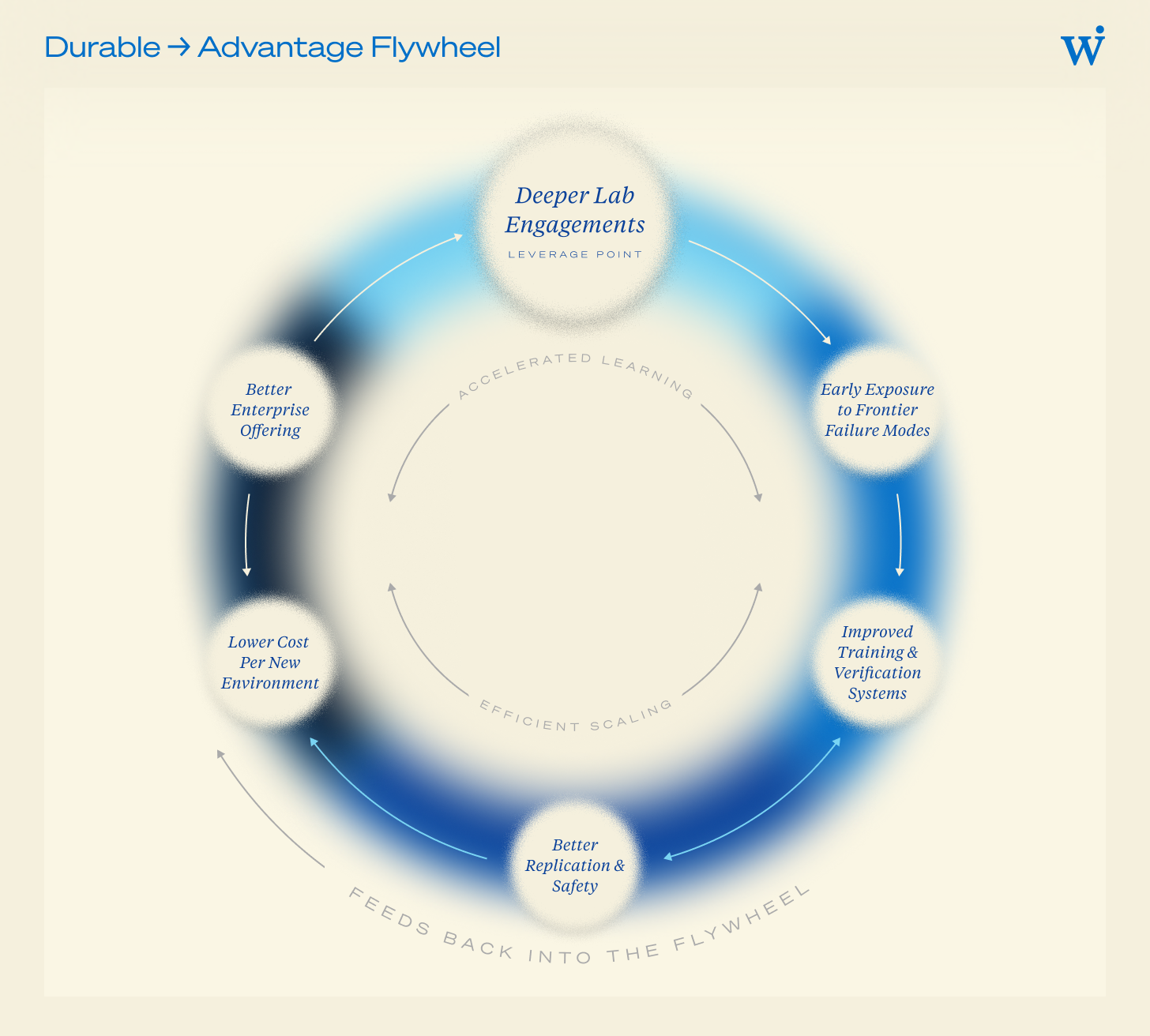
Deeper lab engagements are the leverage point: each turn of the loop lowers the cost of every new environment and strengthens the enterprise offering, which funds the next, deeper round of lab work.
Deeper lab engagements expose Bespoke to frontier failure modes earlier than anyone outside the labs sees them. Those failures sharpen its training and verification systems, which improve replication and safety, which lower the cost of standing up each new environment, which strengthens both the lab and enterprise offerings — and funds the next, deeper round of lab work. Early access compounds into lower marginal cost and a widening lead. An on-demand vendor cannot easily break into a loop it has no entry point to.
Bespoke is already inside it. Revenue has compounded rapidly over the past year, led by frontier-lab contracts — and the enterprise motion is no longer theoretical. Bespoke already counts major enterprises among its customers, spanning developer tooling, financial software, and data platforms, using GEPA-based agent optimization to make their production agents reliable. The same Expert and Environment Engines that train frontier models power that enterprise work, which is why the two reinforce each other rather than compete.
The market follows the flywheel. The data market serving frontier labs is on the order of $6 billion today; the enterprise agent-optimization market it opens into is, by our estimate, an order of magnitude larger. Frontier-lab credibility is what makes the enterprise motion believable — the tooling that hardens a frontier coding model is what a bank or an insurer needs before it puts an autonomous agent into production. Few companies earn the right to sell into both. The ones that do sit at the center of how agents get built.
Why Wing
Wing has invested in the data and AI infrastructure layer since before it collided with agents. We have seen this shape before — a research-led team with a data and verification advantage that compounds, selling first to the most demanding buyers in the market before the category is fully formed, then carrying that credibility into the enterprise. It is the same pattern as the infrastructure businesses we have backed through prior platform shifts.
Our bet is simple: the team that earns the trust of the labs in the hardest domains will own the layer on which every agent — frontier and enterprise — is trained and verified. Bespoke Labs has the team, the research, and the early lab trust to be that company. We are proud to partner with Mahesh, Alex, and the team building the infrastructure that programs the next generation of agents.


